Ledger's Three Data Breaches Expose 270,000+ Users' Home Addresses

At 11 PM, Michael, a Ledger user in San Francisco, received an email. It contained his full name, home address, and even the exact order number from his 2023 Ledger Nano X purchase. The sender claimed to be "Ledger Official Support" and demanded immediate "security verification," warning that his assets were at risk.
This nightmare is now unfolding for many users. On January 5, 2026, blockchain investigator ZachXBT disclosed on X that Global-e, Ledger's third-party payment processor, had suffered a data breach. Soon after, affected users began receiving notifications: their names, shipping addresses, phone numbers, emails, and detailed order information had been leaked. [1]
Ledger officials stated that private keys and wallet assets remain secure, but this doesn't mean there's nothing to worry about. When malicious actors can link blockchain addresses to real identities, they can use a string of characters to locate targets in the physical world.
Three Levels of Risk: From Spam to Wrench Attacks
This user data leak could create a cascading threat chain, escalating from online harassment to wrench attacks.
Risk 1.0: Phishing and Spam
This is the most immediate consequence of a data breach. Your inbox and phone will be flooded with spam. Attackers will use your purchase history to send highly customized phishing emails like "order confirmations" or "shipping updates," tricking you into clicking malicious links or downloading malware.
Risk 2.0: Precision Social Engineering Attacks
Social engineering attacks are when attackers use your personal information to impersonate trusted entities and gain your confidence.
When attackers have your full name, shipping address, and order details, the credibility of their scams skyrockets. Like what happened to Michael, they can provide personalized "one-on-one service." Whether it's a "security recall" or "mandatory firmware upgrade," even experienced users can fall victim to these highly contextualized scams.
Risk 3.0: The Brutal Reality of Wrench Attacks
When your home address is exposed, attackers can not only check your asset holdings through your blockchain address but also show up at your door.
"If we can't hack in, we'll just rob them directly." This is what a convicted crypto robbery gang member said in court. [2]
The shift from online hacking to offline violence is accelerating. According to data from security consultant Jameson Lopp, over 215 crypto-related violent attacks have been recorded globally since 2020, with cases nearly doubling in 2025. [2]
In April 2024, a Chinese family in Canada lived through a nightmare. Four robbers disguised as delivery workers broke into their home, torturing a family of three for 13 hours with methods including waterboarding, beatings, and sexual assault, ultimately stealing $1.6 million worth of Bitcoin. The trigger? The homeowner had simply mentioned making money from crypto investments in their community. [3]
These horrifying cases represent the brutal reality of wrench attacks. Attackers don't need to crack your device; they just need violence to force you to hand over your assets. This Ledger data breach has paved the way for precisely this type of attack.
Three Breaches, Users Pay Every Time
Looking back at Ledger's history reveals a recurring nightmare. Every time it's a "third-party issue," but users always bear the consequences.
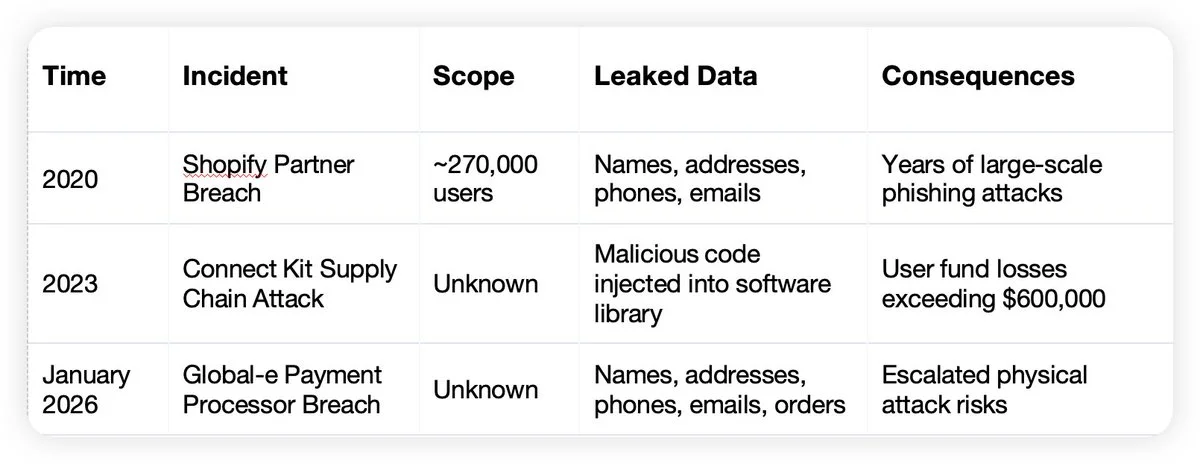 92161c65-9e5c-49a0-adb2-1ccf5c9d8dbc.jpeg
The root cause lies in a common industry practice: outsourcing core business operations to third-party service providers. E-commerce systems, order processing, customer service... When a brand splits these data-carrying operations across countless external vendors in pursuit of efficiency and cost savings, a fragile "data transfer chain" forms. Each additional link increases the probability of user information leakage.
"Security" Should Never Be Outsourced
So what would a team that truly prioritizes user security do? The answer is to bring all operations that touch sensitive user information in-house and manage them vertically.
Professional security architecture requires isolating risks at the source. This means:
• In-house customer service: All customer communications occur within proprietary, controlled systems, avoiding data risks from third-party tools or ticketing systems.
• Minimal data collection: Only collect the minimum information necessary to complete transactions, with strict access controls and encrypted storage.
This operational model is more complex and costly, but it fundamentally eliminates the possibility of data flowing externally. From day one, OneKey has strictly followed these principles, completing all core operations including e-commerce, orders, and customer service with our own team in-house. As a result, we have maintained a record of zero user information leaks and zero user asset losses over the past several years.
What Should You Do If Your Data Has Been Leaked?
If you've received a Ledger data breach notification, take these steps immediately:
Use secure shipping addresses: Whenever possible, use non-residential addresses (like package pickup points or office addresses) for deliveries, and use pseudonyms for recipient names.
Isolate personal information: Use separate, infrequently-used email addresses and phone numbers for registration, separating your "on-chain identity" from your "real-world identity."
Stay vigilant and verify through multiple channels: Be skeptical of any communication claiming to be official. Before taking any sensitive actions, verify through multiple independent channels like official websites and official Twitter accounts.
Choose privacy-focused brands: When selecting a hardware wallet, examine not just its technical security but also its operational model. Prioritize brands that keep user data in their own hands.
Users choose hardware wallets seeking peace of mind. When trust is broken, even the most secure hardware cannot restore that sense of security.
References
[1] Ledger. (2026, January 5). Notification of Data Breach.
[2] Bloomberg. (2026, January 6). Small-Time Crypto Investors Are Facing Violent Attacks.