Security Blind Spots of Hardware Wallets: Analyzing the Covert Threat of Supply Chain Attacks

Security Blind Spots of Hardware Wallets: Analyzing the Covert Threat of Supply Chain Attacks
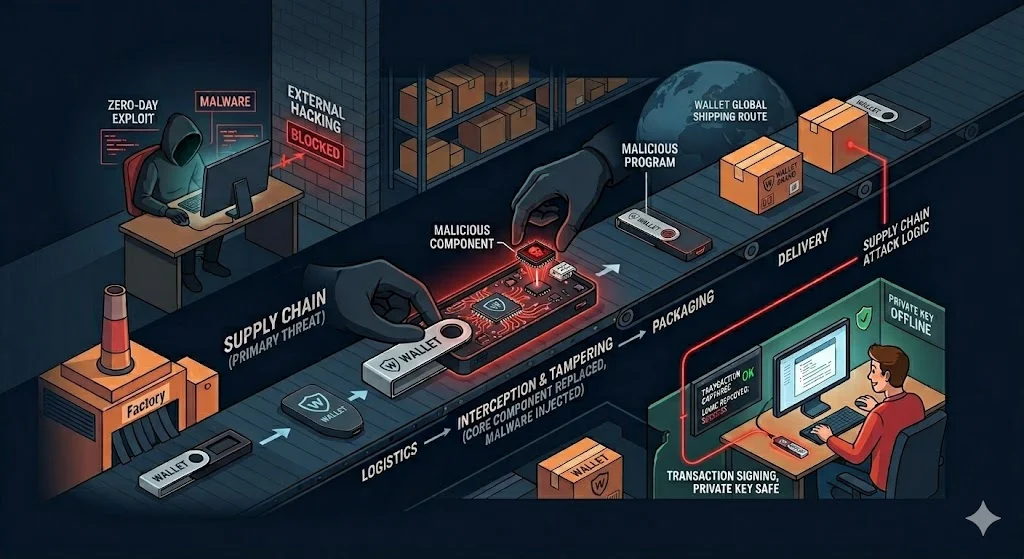
The primary security threat facing hardware wallets often stems from supply chain manipulation rather than direct hacker intrusions. The intent of purchasing a hardware wallet is to achieve absolute offline storage of private keys, safeguarding against zero-day vulnerabilities or Trojan viruses. In reality, the probability of a device being remotely hacked is extremely low, with the real risk lurking in the end-to-end flow from ordering to transaction signing.
This threat is exceptionally covert: a device may have been implanted with malicious programs or had components replaced before delivery. Even if a user observes the device running "normally," each transaction signed might be controlled by the attacker's preset logic.
Fragility of the Trust Chain
The core technological advantage of hardware wallets lies in creating a completely isolated operating environment: private keys are generated and stored offline, with each transaction requiring physical confirmation on the device screen. This mechanism ensures that even if the host device (like a computer) is infected with malware, the private key cannot be directly accessed, significantly raising the bar for remote attacks.
However, this security system is built on a crucial premise: users must receive an untampered device, official firmware, genuine software, and secure connections. Once any link in this supply chain is compromised, attackers do not need to spend computational power to break the underlying security chip; they can simply provide a false infrastructure at the initial stage. If users fail to effectively verify the entire interaction chain, the so-called "self-custody" essentially hands asset control to a supply chain filled with unknown risks.
Analysis of Typical Attack Scenarios
To clearly reveal the operational paths of these risks, below we summarize five typical attack scenarios that have occurred in the industry:
Scenario 1: Counterfeit and Tampered Devices
Attackers often forge packaging seals identical to official ones, sell tampered devices with pre-installed backdoors, and may even include a counterfeit "official mnemonic card" in the package. Once users import mnemonics according to the card and transfer assets, attackers can immediately gain control. The Kaspersky team once analyzed a batch of counterfeit Trezor hardware wallets and found that the internal chips had been physically replaced and the firmware verification mechanism removed. In this situation, users are essentially using a universally transparent key. [1]
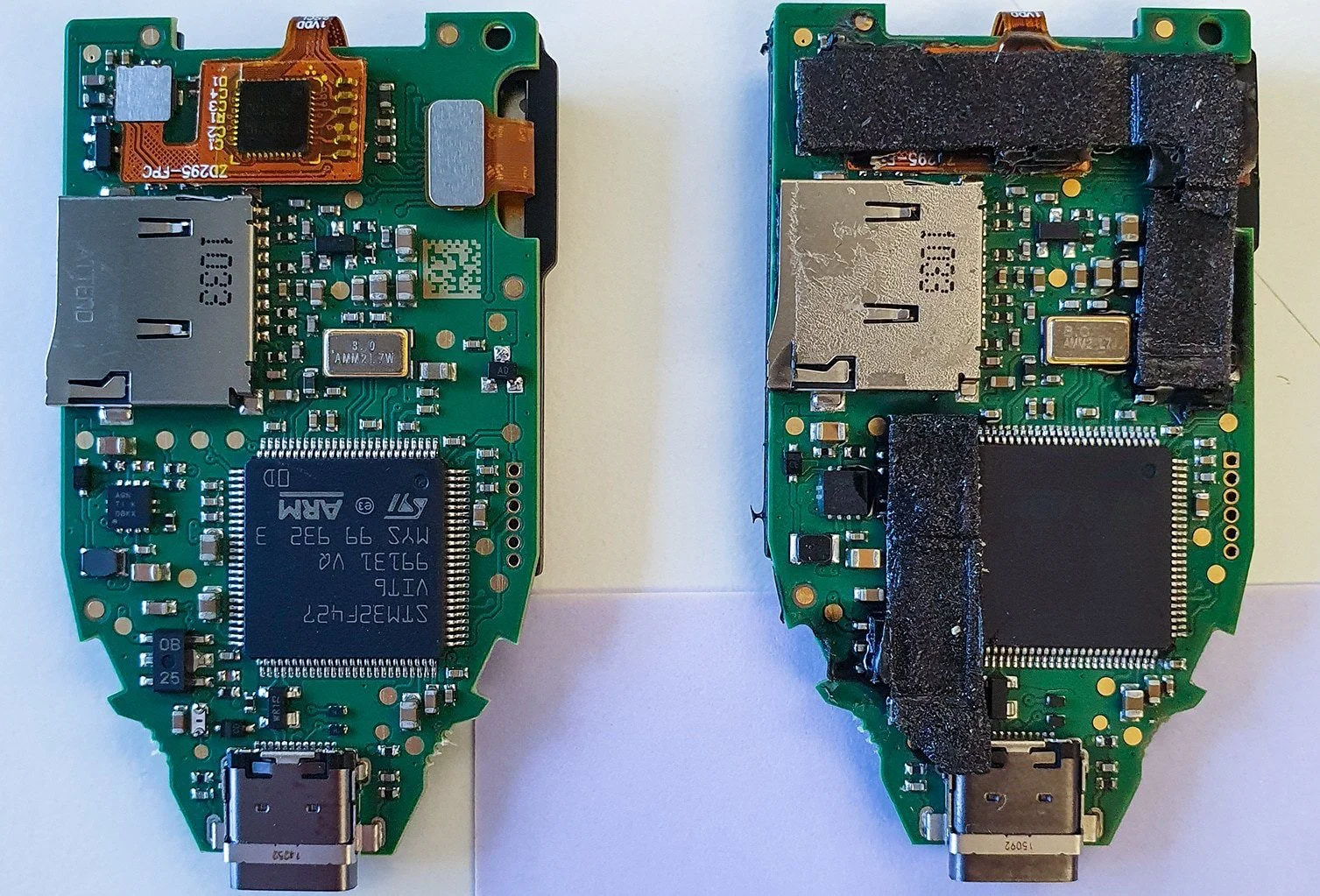 Counterfeit Device Disassembly
Scenario 2: Malicious Firmware and Fake Updates
Some users tend to develop absolute security complacency after purchasing hardware wallets. Attackers exploit this by faking system upgrade prompts, guiding users to visit fake update portals, and installing tampered firmware or core components. Additionally, inducing users to "downgrade" devices to vulnerable historical versions is a common tactic. The fundamental purpose is to fully control the device's display content (such as signature prompts, payee addresses) or steal users' confidential information.
Scenario 3: Front-end and Dependency Poisoning
When hardware wallets interact with blockchain networks, they often need to connect to various dApps. dApp front-end code, third-party scripts, and underlying dependency libraries are also vital parts of the supply chain. The industry has experienced severe dependency poisoning incidents: attackers breached software distribution channels and injected malicious code into widely used connection libraries. This led to multiple dApp pages using the library being dynamically implanted with malicious logic, inducing users to sign transactions authorizing asset transfers. [2] In such incidents, the hardware device itself was not breached; attackers achieved asset theft merely by polluting the software supply chain.
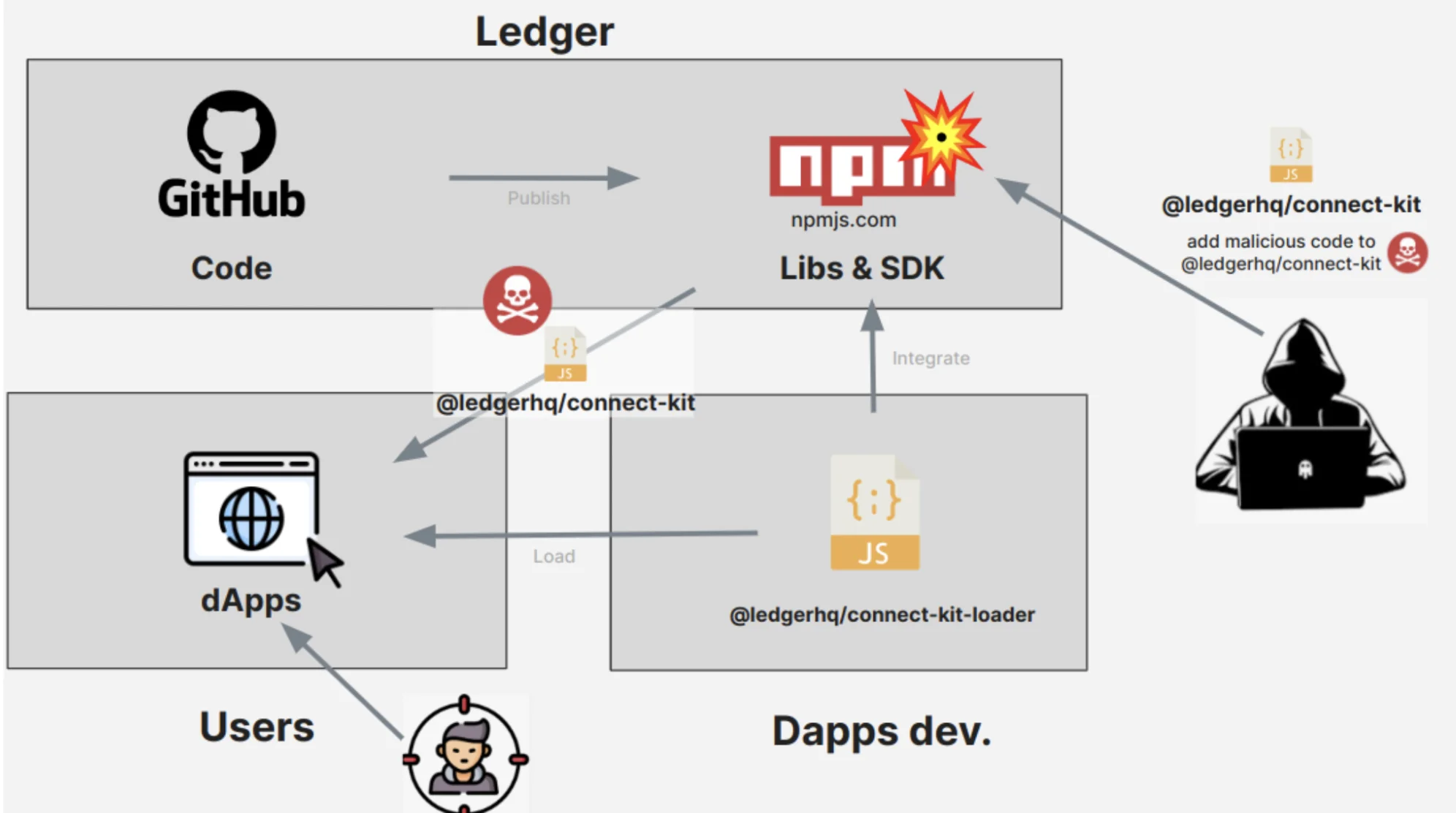 Dependency Poisoning
Scenario 4: Physical Address and Order Information Leakage
The potential threat of data breaches to hardware wallet users is often severely underestimated. Once attackers obtain users' names, phone numbers, shipping addresses, and order details, they can conduct precise social engineering attacks. For example, they may use exact model and order time for targeted phishing; impersonate the official risk control team requiring urgent verification; or even directly send Trojan-laden replacement devices or anti-phishing cards to the user's physical address. Previously, some hardware wallet manufacturers and third-party e-commerce partners experienced large-scale user database leaks, leading to the exposure of a large amount of order data containing physical address information and significantly increasing the success rate of subsequent targeted scams. [3][4]
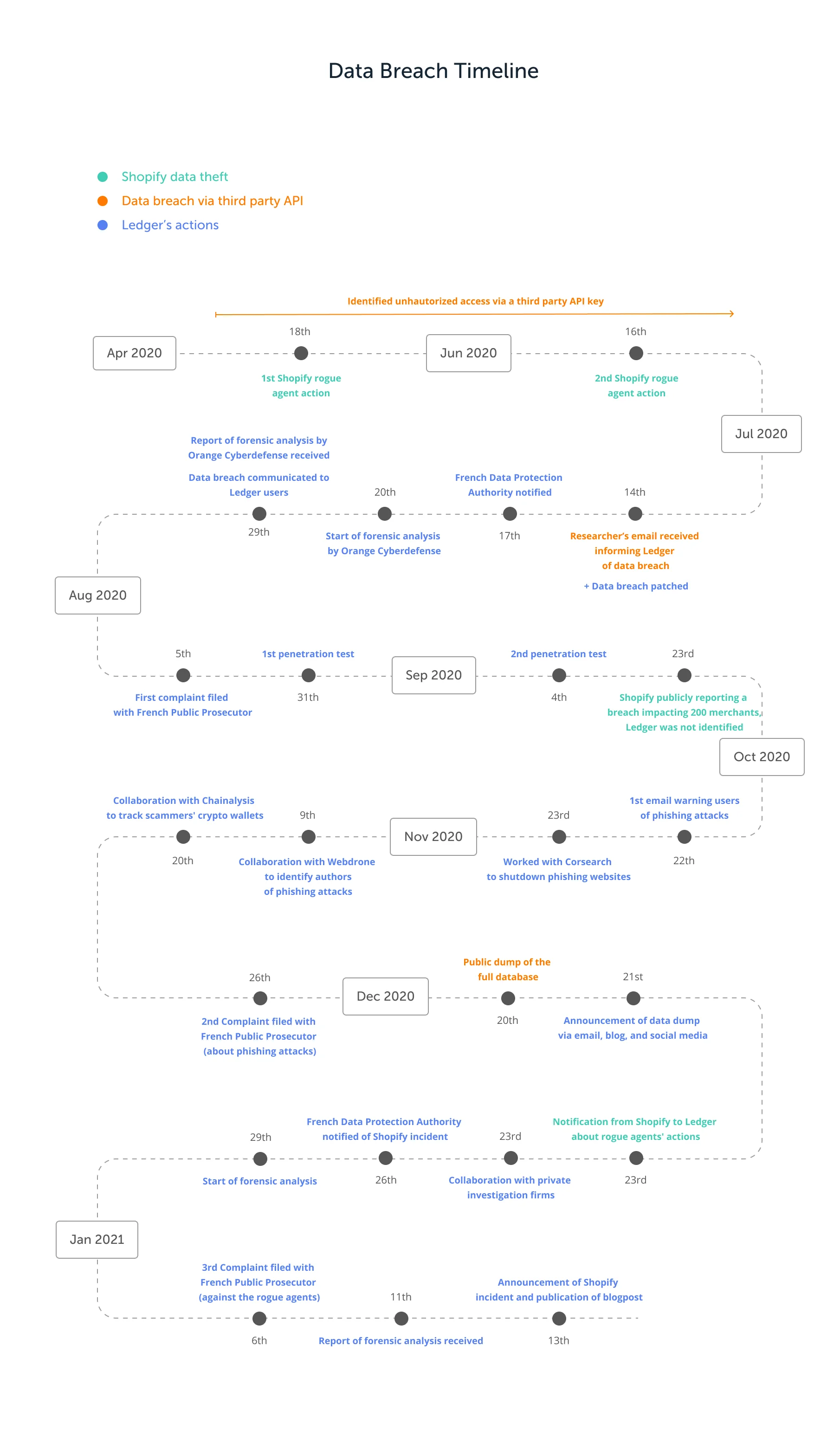 Data Breach
Scenario 5: Social Engineering and Fake Customer Service
The ultimate goal of supply chain attacks is usually to trick users into revealing core secrets or signing malicious transactions. Attackers often disguise themselves in seemingly compliant processes, such as claiming the device is at risk and needs mnemonic verification for ownership; requiring mnemonic import into web tools for secure migration; prompting installation of emergency security patches; or inducing users to sign seemingly harmless zero-amount authorization transactions (Permit). Although hardware can isolate private keys, it cannot eliminate psychological vulnerabilities, especially when attackers possess users' real order information, increasing the enticing nature of such scams.
These five scenarios expose specific risks in the crypto asset field, but it should be recognized that supply chain security risks are not unique to this field. Such attacks are equally commonplace in the traditional tech industry. For example, in the SolarWinds incident, attackers tampered with the software update chain, mixing backdoor programs into official distribution packages; in the Codecov incident, attackers tampered with the official upload tool, stealing sensitive environment variables from the continuous integration environment; the CCleaner incident similarly involved implanting malicious code into legitimate software updates. These security incidents of well-known companies indicate that attackers often prefer finding breaches in the most vulnerable areas, including official updates, legitimate download channels, and signed installation packages.
OneKey Verification System and Operational Principles
In response to the above threats, OneKey's system design considers supply chain risks as normalized threats for prevention, establishing a security mechanism based on user self-verification:
- Device Authentication Mechanism: Provide anti-counterfeiting verification functionality through the OneKey App to ensure the integrity of the hardware after production.
- Firmware Consistency Check: Support users in initiating firmware verification by comparing device firmware with OneKey's open-source firmware, preventing malicious code injection.
- Open Source and Self-Verification Process: Provide guidance on checksum and signature, enabling users to verify code and firmware themselves, breaking the technological black box.
- External Security Audit: Regularly engage third-party professional security agencies like SlowMist for code audits and publicly disclose reports.
To further reduce supply chain risks, users should adhere to the following core verification principles in daily operations:
- Purchase and Receipt Channels: Strictly limit purchases to official or officially authorized channels, remaining highly vigilant against devices offered at abnormal low prices or private resale. Upon receiving the device, check the physical anti-counterfeiting seal, but do not regard it as the sole proof of authenticity.
- Initialization Setup Standards: Be sure to personally generate and handwrite the mnemonic on the hardware device screen. Any pre-printed mnemonic cards or processes requiring quick import via QR code should be deemed fraudulent. After initialization, verify the device and firmware immediately.
- System Update Path: Obtain firmware and software updates only through official websites or official Apps. Prohibit clicking on any private message links or group file upgrade packages, reject any downgrade requests, or instructions requiring mnemonic input for security verification.
- Daily Use and Signature Checks: Before signing any transaction, carefully verify the target address, transaction amount, associated network, and smart contract information on the hardware device screen. Reject operations involving indefinite permissions that cannot be understood. Alerts citing "emergencies" or "limited-time processing" should be assumed to have high fraud risk.
- Social Engineering Prevention: Absolutely forbid providing mnemonics or PIN codes to any third party. When contacted by someone claiming to be official customer service, remain silent and conduct cross-verification through official public channels.
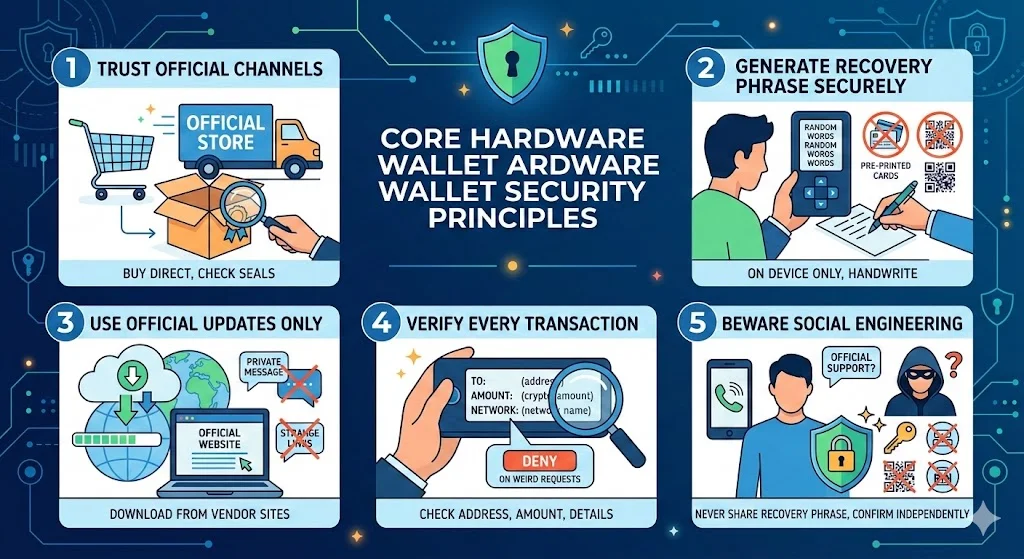 OneKey Verification System
Conclusion
Hardware wallets achieve the physical isolation of private keys, a crucial foundation for securing assets. However, supply chain security incidents repeatedly indicate that physical and social engineering risks outside the system are equally fatal. The security of digital assets should not be built on blind trust but rooted in a stringent cross-verification mechanism. Implementing the principle of "no verification, no trust" is the only effective path to combating complex supply chain threats.
Reference Links
[1] Kaspersky - Fake Trezor Hardware Wallet Disassembly Analysis: https://usa.kaspersky.com/blog/fake-trezor-hardware-crypto-wallet/28299/
[2] Ledger - Security Incident Report (Connect Kit Dependency Poisoning): https://www.ledger.com/blog/security-incident-report
[3] Ledger - User Data Breach Incident Update: https://www.ledger.com/blog/update-efforts-to-protect-your-data-and-prosecute-the-scammers
[4] Cointelegraph - Ledger Third-Party E-commerce Data Breach Report: https://cointelegraph.com/news/ledger-data-incident-global-e-not-platform-breach