Can Quantum Computing Break BTC? A Clear Guide to Post-Quantum Security

Ключевые выводы
• Quantum computers pose real future risks to asymmetric cryptography through Shor’s and Grover’s algorithms.
• Symmetric encryption and hashing remain strong but require higher bit-strength to stay quantum-resistant.
• NIST has standardized PQC algorithms: ML-KEM for key agreement, ML-DSA for signatures, and SLH-DSA as a hash-based fallback.
• OneKey’s AES-256 and PBKDF2-HMAC-SHA256 already provide NIST PQC Level 5–grade security.
• OneKey is preparing end-to-end PQC upgrades, including ML-KEM, ML-DSA, and strengthened hashing.
• Bitcoin’s primary quantum risk lies in exposed public keys, not hashed addresses.
• OneKey’s BTC Multi-Address Mode reduces exposure by rotating fresh change addresses automatically.
• Users should avoid address reuse, migrate from old addresses periodically, and consider PQC readiness in long-term planning.
The debate around “whether quantum computers can eventually crack Bitcoin” has been heating up again.
Today’s cryptographic mechanisms are still extremely secure for classical computers — even for GPUs and supercomputers. But quantum computing introduces algorithms that can dramatically speed up certain types of attacks in the future.
This is exactly why post-quantum cryptography (PQC) exists: to upgrade cryptographic systems before quantum computers reach practical scale, ensuring they remain secure even if brute-force capabilities improve by several orders of magnitude.
In this article, we’ll walk through four key topics: • how quantum computing works and where the risks come from, • what PQC is and why it matters, • how NIST defines PQC security levels, • and how wallets can start preparing today.
How Quantum Computing Works — And Where the Risk Appears
Most modern cryptographic systems (including blockchains) rely on four foundational types of algorithms:
- Symmetric encryption (AES, ChaCha20, etc.)
- Asymmetric encryption (RSA, ECDH, ML-KEM, etc.)
- Hash algorithms (SHA, HMAC, etc.)
- Digital signatures (ECDSA, ML-DSA, etc.)
Their confidentiality is based on mathematical problems that are extremely expensive for classical computers to reverse. For example:
- guessing the original input from encrypted output,
- or deriving a private key from a public key.
Even with today’s supercomputers, many of these tasks would take decades — or thousands of years.
Quantum computers, however, enable two powerful new algorithms:
• Shor’s algorithm
Provides super-polynomial speedups in factoring and discrete logarithms. → This directly threatens RSA, ECDH, and all ECC-based signature schemes including ECDSA.
• Grover’s algorithm
Provides a quadratic speedup for brute-force search. → This affects symmetric encryption and hash functions by effectively cutting their bit-strength in half.
In other words:
- Asymmetric cryptography is the most vulnerable,
- Hashing and symmetric algorithms remain safer, but require higher bit-strength to stay robust.
Because of this, the wider industry is now shifting into a PQC-Ready phase — preserve existing infrastructure where secure, and introduce new lattice-based schemes where classical algorithms can no longer hold up.
NIST selected:
- ML-KEM → next-generation key agreement (replacing ECDH)
- ML-DSA → next-generation digital signatures (replacing ECDSA)
- SLH-DSA → hash-based fallback signature scheme
These are specifically designed to resist Shor-class quantum attacks.
NIST PQC Security Levels: Why They Matter
NIST defines five post-quantum security levels (Level 1–5), describing how well an algorithm resists both classical and quantum attacks.
A simplified interpretation:
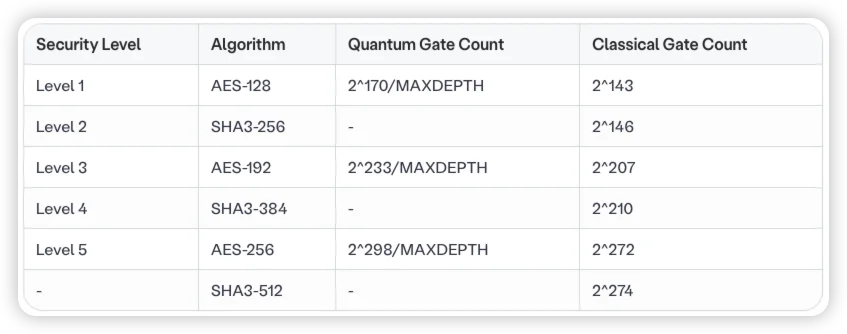
If a system maintains security comparable to AES-256 even under quantum attack, it's considered Level 5 — the highest category, suitable for long-term and critical-infrastructure protection.
OneKey’s Current Cryptography
The OneKey App uses:
- AES-CBC-256 for symmetric encryption
- PBKDF2-HMAC-SHA256 for key derivation
What this means technically
- AES-CBC-256 provides strong security even with Grover-based quantum speedups.
- PBKDF2-HMAC-SHA256 remains one of the most widely trusted derivation functions, transforming variable-length inputs (such as a PIN or password) into a 256-bit key.
It’s used across major security infrastructures, including Android and iOS device-unlock systems.
Because PBKDF2’s security overlaps with symmetric cryptography, its strength under quantum conditions depends on reversing the derived key to the original password (not finding a collision). Under this model, it maintains security equivalent to PQC Level 5.
Result
Assuming the secrets remain protected and key derivation isn’t compromised, OneKey’s current scheme provides NIST PQC Level 5 strength.
We are already preparing the next phase of upgrades:
- adopting ML-KEM for key agreement,
- migrating signatures to ML-DSA,
- increasing hash strength across the stack, to ensure the entire product ecosystem transitions smoothly into the post-quantum era.
Bitcoin’s Post-Quantum Situation
Let’s take Bitcoin as a concrete example.
Where BTC is Vulnerable
Bitcoin uses ECDSA over secp256k1. If a quantum computer with sufficient qubits and controllable circuit depth becomes available, Shor’s algorithm could derive a private key from its public key — potentially within 24 hours on high-performance quantum hardware.
But there’s an important detail:
- Unused BTC addresses are safer because only the hash of the public key is revealed (hash reversal ≈ PQC Level 5 difficulty).
- Addresses that have signed transactions are exposed because the public key becomes visible on-chain, making them theoretical targets.
How OneKey mitigates this
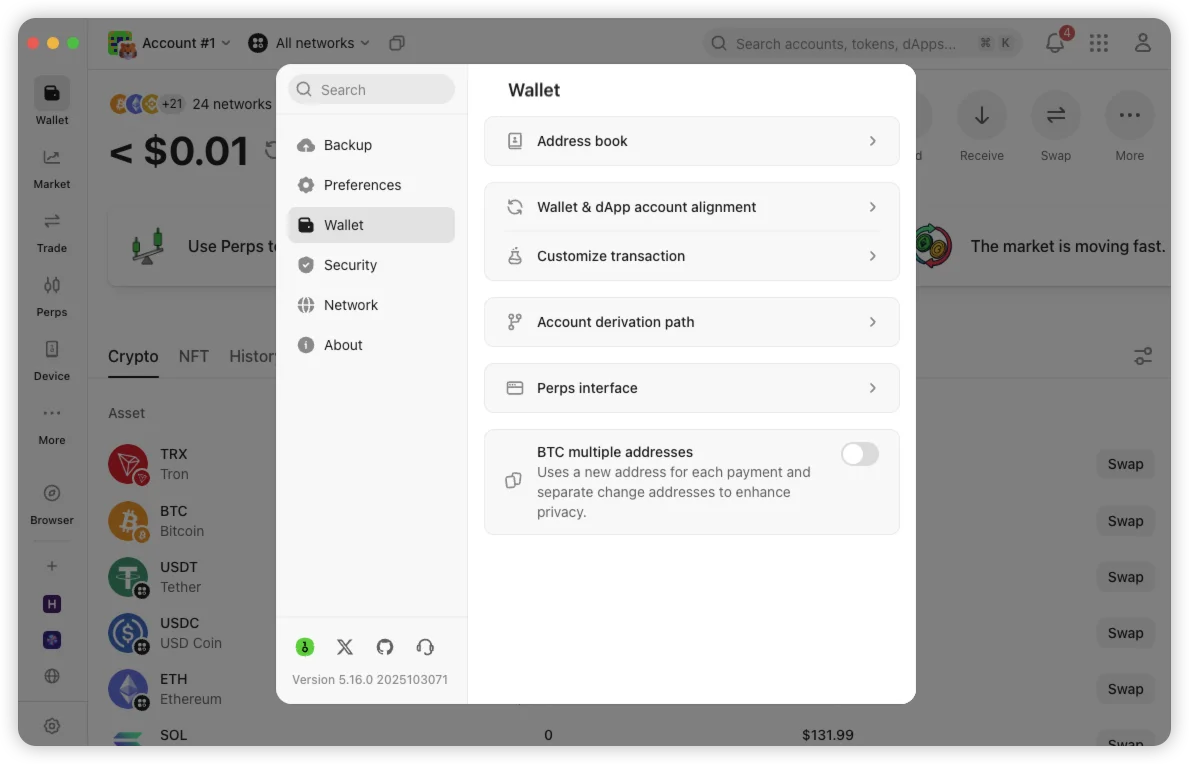
The OneKey App supports BTC Multi-Address Mode. After every transaction, the app automatically generates a fresh change address, meaning:
- its public key remains unrevealed,
- privacy increases,
- long-term quantum exposure decreases.
Good news & challenges
No quantum computer today can break Bitcoin’s signature scheme. However, upgrading Bitcoin’s signing algorithm to a PQC variant in the future will be extremely complex and require broad consensus across the ecosystem.
What BTC users should do today
- Prefer addresses with unrevealed public keys
- Avoid address reuse
- Periodically migrate away from older addresses
- Consider post-quantum safety as part of long-term asset planning
Not panic — but preparation.