How Long Does a TRC20 Transfer Take? Confirmations, TRONSCAN, and Missing Deposits

Key Takeaways
-
Copy the TXID in OneKey first. TRON’s roughly 3-second average block time is not a deposit promise; platform credit also depends on confirmations and internal processing.
-
For a missing deposit, find the TXID and then branch by Success, Pending, Failed, or no record.
-
If the chain shows Success but the platform has not credited it, submit the TXID to the platform instead of repeating the transfer or disclosing your recovery phrase.
If TRC20 USDT has not arrived in OneKey, open the transaction details, copy the TXID, and check its on-chain status on TRONSCAN. TRON produces a block about every 3 seconds on average, but that is not a promise that funds will arrive in 3 seconds. An exchange or payment platform may wait for additional confirmations, check the minimum deposit, and finish internal accounting.
First distinguish three meanings of "arrived"
Broadcast means the sender submitted a signed transaction to the network, not that a block already includes it. Successful on-chain means the transaction executed and was recorded; you should still verify the recipient, token contract, amount, and balance change. Credited by the platform means an exchange or merchant system updated the user's balance after its confirmation and risk-control requirements were met.
If a wallet says that a request was submitted but shows no TXID, do not treat it as on-chain success. If an exchange says "processed," also confirm that it generated an on-chain hash. A block explorer cannot look up a transaction without a TXID, so return to the sender or sending platform first.
How to check in OneKey and TRONSCAN
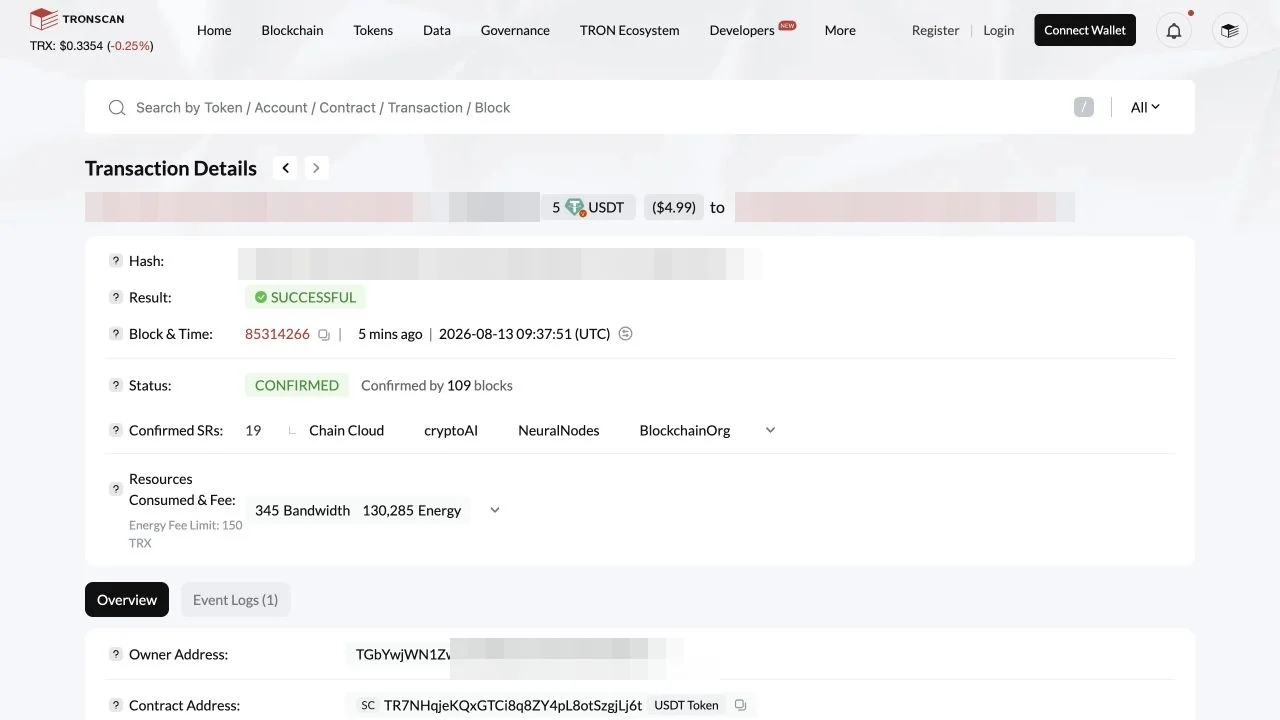 TRONSCAN shows a successful and confirmed 5 USDT transaction
Query example: TRONSCAN shows this 5 USDT transaction as Successful and Confirmed and lists its Bandwidth and Energy. This proves on-chain success, not that an exchange has completed its internal accounting.
- Copy the complete TXID from OneKey transaction history or the sending platform.
- Open TRONSCAN and paste the TXID into the search field.
- Check the status, time, sender, recipient, token contract, and amount.
- Review the confirmation state and the Energy, Bandwidth, and fees consumed.
Success means on-chain execution completed. Pending means the network still needs to process it. Failed means execution failed; move to failure troubleshooting instead of continuing to treat it as a delayed deposit. If no result appears, check that the hash is complete, the network really is TRON, and the sending platform actually broadcast the transaction.
What if the transaction succeeded on-chain but the exchange did not credit it?
Check the exchange's confirmation requirement, minimum deposit, address, and other conditions for TRC20 USDT. Confirm that the recipient exactly matches its deposit page, then give the platform support team the TXID, asset, network, amount, and time. Do not send the same amount again in a hurry.
If the recipient is a personal wallet and the on-chain record and balance have changed but the app has not refreshed, refresh the asset state and verify that the official USDT contract is displayed. Never import your recovery phrase into an unfamiliar website to "sync the balance."
When does the wait become abnormal?
There is no universal number of minutes. Use the state rather than subjective waiting time: with a TXID and Pending, continue to observe; with Success but no platform credit, follow the platform's confirmation and maintenance policy; with Failed, inspect the receipt; with no TXID, return to the sender and investigate broadcast. Network load and platform maintenance can both extend processing.
Address lookup versus TXID lookup
An address search shows an account's public transaction history and token balance, which helps confirm whether the recipient account changed. A TXID identifies one unique transaction and shows its result, block, resource use, and participants. In a dispute, exchange the TXID first because a balance screenshot does not prove a specific transaction and may include other payments.
How common platform statuses map to the chain
"Under review" is usually an internal platform process and may not yet have a TXID. "Processing" can mean the transaction was constructed but not broadcast. "Completed" should normally have an on-chain hash, but platform wording is not standardized. The block explorer remains the most reliable public evidence. If a platform has suspended TRON deposits for maintenance, even a Success transaction may wait for credit until service resumes.
Prepare all information before contacting support
Collect the asset, network, amount, sender and recipient addresses, TXID, time, page-status screenshot, and platform order number. Submit only public transaction information—never a recovery phrase, private key, verification code, or remote-control access. Official support does not need secret data to inspect a public on-chain transaction.
Risk Warning
Average block time and historical deposit speed do not guarantee this transaction's arrival, and a block explorer cannot replace the receiving platform's internal accounting conclusion. A TXID is not a recovery phrase; anyone requesting a recovery phrase or private key to "recover a deposit" is untrustworthy.
References
- TRON Block Production
- TRONSCAN
- TRONSCAN: Transfer not received
- OneKey: Asset not received
- OneKey: Send and receive assets
FAQ's
There is no fixed time that can be promised. Check the TXID on-chain first; exchanges also apply confirmation, maintenance, and internal-review rules.
First verify the network and that the hash is complete. If it still cannot be found, ask the sending platform whether it was actually broadcast.
Check the recipient, token contract, and network. Refresh a personal wallet’s token state; for an exchange, wait for its accounting process.
Do not immediately repeat the payment. First determine whether the original may still be included on-chain.
No. TRONSCAN requires only a public address or TXID. A page asking for a recovery phrase is a high-risk signal.