How Much Is the USDT TRC20 Transfer Fee? TRON Energy, Bandwidth, and TRX Calculation

Key Takeaways
-
A TRC20 USDT fee combines Bandwidth, Energy, and TRX burned for resource shortfalls; an exchange withdrawal fee is separate.
-
Each activated externally owned account receives 600 free Bandwidth per day but no free Energy; the dynamic Energy factor can change actual cost.
-
OneKey checks resources during sending. A temporary free subsidy and Energy rental payable in USDT follow two different rule sets.
There is no permanently fixed TRX fee for a USDT TRC20 transfer. OneKey shows resources and an estimated fee on the send confirmation page. The transaction first uses available Bandwidth and Energy; any shortfall then burns TRX under current chain parameters. When the product feature is currently available, you may also rent Energy inside OneKey. Transaction bytes, account resources, contract execution path, dynamic Energy factor, and chain parameters all affect the final cost, so a fixed quote can represent only one moment and one class of transaction.
 Official public TRON logo
Official public TRON brand logo. Source: TRON Media Kit. Used only for brand identification, not as protocol documentation.
Bandwidth: the cost of recording transaction data
Every non-query transaction on TRON consumes Bandwidth equal to the number of bytes written on-chain. Each activated externally owned account receives 600 free Bandwidth per day, recovering gradually over 24 hours. Staking TRX can provide more. When free and staked Bandwidth are insufficient, the network burns TRX at the current Bandwidth unit price.
As of 2026-08-13, the current parameter in TRON's official documentation lists a burn price of 0.001 TRX per Bandwidth unit. This is a governable chain parameter, so query the latest value before calculating. The "5000 free Bandwidth per day" figure often found in older material is outdated and must not be used for a current budget.
Energy: the cost of executing the USDT contract
A TRX transfer mainly consumes Bandwidth. Sending USDT calls a TRC20 smart contract, so it also consumes Energy. Energy has no daily free allowance. It can be obtained by staking TRX, receiving a resource delegation, or renting; a remaining shortfall burns TRX.
As of 2026-08-13, TRON's official documentation lists the Energy price as 100 sun per unit, or 0.0001 TRX. Popular contracts can also be affected by the dynamic Energy model. A simplified relationship is: actual Energy = base Energy × (1 + energy_factor). The energy_factor changes according to the contract's resource use during a maintenance cycle. The same transfer amount does not therefore imply the same Energy, and a fixed Energy number circulating online is not a permanent quote.
How to calculate a TRC20 fee
Ignoring special charges such as account creation, use this simplified formula:
estimated TRX burned = Bandwidth shortfall × current Bandwidth price + caller Energy shortfall × current Energy price
The Bandwidth shortfall is the required transaction bytes minus free or staked Bandwidth available. The Energy shortfall is the caller's actual Energy responsibility minus available or delegated Energy. The on-chain receipt is the final result. An exchange's "withdrawal fee" is set by the platform. It is not the same as the transaction's on-chain resource consumption and may not change with TRON parameters.
The deduction order and fee_limit
- The transaction first consumes available free or staked Bandwidth; a shortfall burns TRX.
- A contract call first consumes Energy available to or delegated to the caller.
- If Energy remains insufficient, the network burns TRX at the current Energy price.
- Energy rented before sending acts as a temporary resource during settlement and reduces the shortfall that would otherwise burn TRX directly.
fee_limit is not simply "the maximum TRX deduction." It is the caller's Energy budget cap expressed in sun. It limits both staked Energy the caller may use and Energy that can be covered by burning TRX. If it is too low, the transaction can fail with OUT_OF_ENERGY even when the account has resources or TRX.
How OneKey subsidies differ from Energy rental
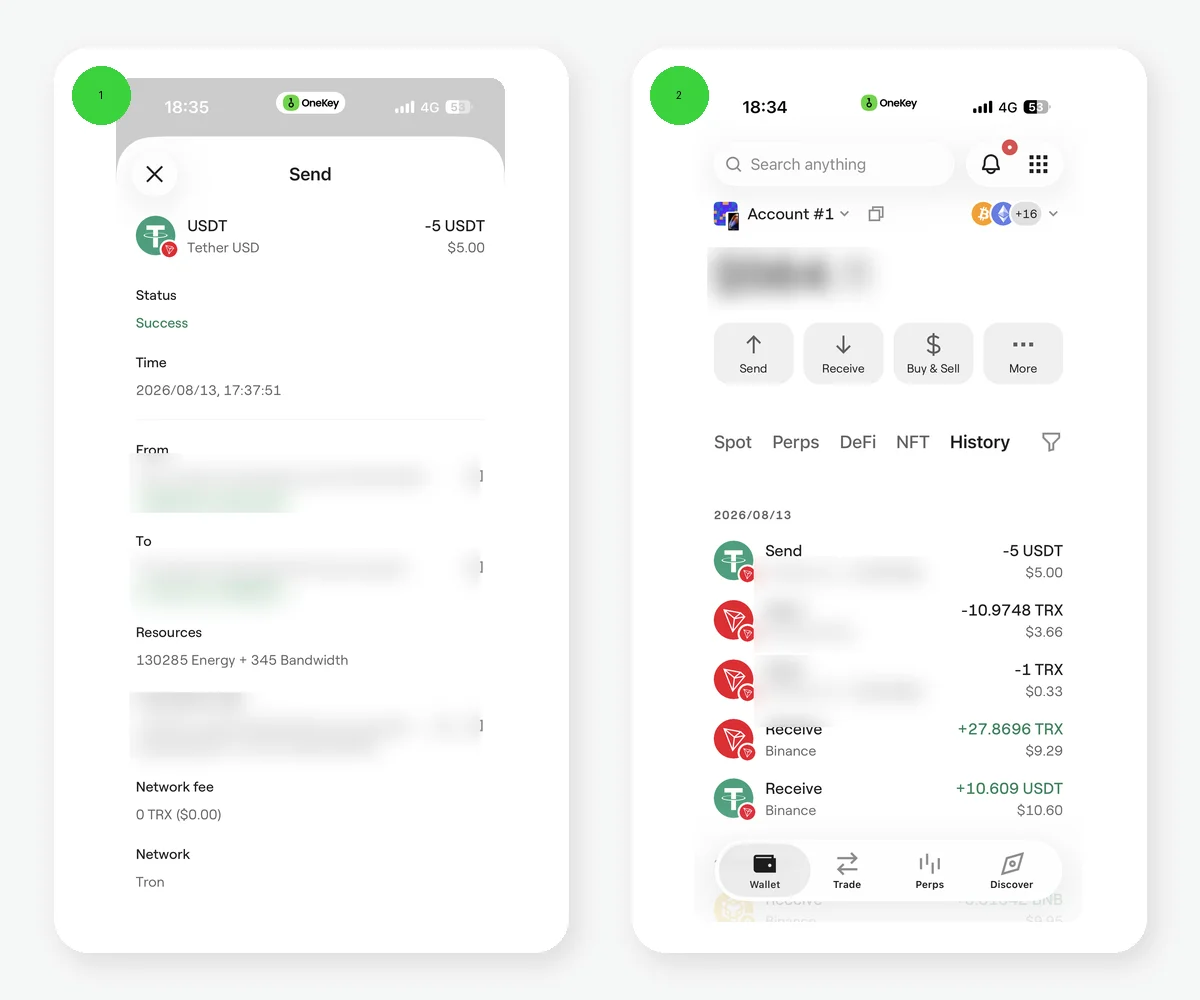 USDT transfer and Energy Rental charges in OneKey history
Test example: the 5 USDT transfer and Energy Rental appear as separate items in history. Even if the USDT transaction detail shows a 0 TRX network fee, include the rental charge in the total cost.
OneKey places resource checks and resolution paths inside the send flow, so users do not have to look for an unfamiliar off-wallet Energy seller first. Under Help Center rules verified on 2026-08-13, the temporary free subsidy currently has these boundaries:
- A daily pool of 1500 grants.
- Each address can claim 1 time every 24 hours and no more than 10 times per month.
- Each IP can claim no more than 15 times per month.
- The grant is valid for 10 minutes after claiming.
- Each transaction is subsidized for at most 65,000 Energy; the user bears any excess.
- Current rules require the address to hold a small amount of TRX; an address with a 0 TRX balance cannot use this free subsidy.
Paid energy rental is a separate feature. When resources are insufficient, OneKey automatically checks and displays a rental prompt, and it currently supports paying the Energy cost in USDT. When the current conditions are met, a transaction can complete even if the address has no TRX. Both subsidies and rentals are variable product rules, not permanent TRON-protocol promises. Use the live app page. For a wallet holding only USDT, see How to send USDT without TRX.
How to reduce surprise fees in OneKey
After starting a transfer, pause on the confirmation page and check available Energy, Bandwidth, the estimated fee, and the recipient. An occasional user can compare the current rental quote with the cost of burning TRX directly. A frequent sender who holds TRX can evaluate staking for resources. When eligible for a subsidy, first check whether its 65,000 Energy cap covers the estimate. OneKey does not promise that rental is always cheaper; the current confirmation page is the correct basis for the decision.
When sending to a new address for the first time, make a small test and retain the TXID. For high-value or batch payments, connect a OneKey hardware wallet to review the transaction summary. Save resource-order and token-transfer TXIDs separately so you can distinguish "resources did not arrive" from "the token transfer failed."
What to check when a fee looks abnormal
- Did you mistake an exchange withdrawal fee for actual on-chain resource cost?
- Does the current account have enough Energy and Bandwidth, and were rented resources delegated to the correct sender?
- Did the USDT contract's current
energy_factorchange, making an earlier estimate unsuitable for this transaction? - Was
fee_limittoo low, causingOUT_OF_ENERGYafter resources were consumed? - Did the transaction trigger account creation or another special on-chain charge?
Build a cost baseline from actual receipts
Frequent users can record available Energy and Bandwidth before sending, the confirmation-page estimate, actual resource consumption in the receipt, and the final TRX burned or paid. Records from the same business path provide a more useful range than a fixed quote copied from the internet.
This history is a budget aid, not a permanent formula. Read the live estimate before every send, especially after an update to chain parameters, the Energy factor of a popular contract, or a OneKey resource option. Businesses and merchants should also include failed retries, rental expiry, and approval overhead in the total cost.
Risk Warning
This article promises no fixed fee, subsidy eligibility, or savings percentage. TRON governance can change chain parameters, and OneKey subsidy and rental rules can also change. Recheck every time-specific value before acting. Failed transactions may still consume resources. Do not buy Energy from an unfamiliar address, do not approve an unknown contract, and always rely on the live OneKey estimate before signing and the on-chain receipt afterward.
References
- TRON Resource Model
- TRON Transactions
- TRON FeeLimit & Energy Cost
- TRON FAQ
- OneKey: TRON Energy and subsidy
- OneKey: Send and receive assets
FAQ's
There is no permanent value. As of 2026-08-13, the official Energy price is 0.0001 TRX, but resource balances, dynamic Energy factors, and chain parameters change the total. Use the pre-send estimate.
The amount is usually not the main variable. Execution path, available account resources, the contract’s dynamic Energy factor, and chain parameters can create the difference.
Bandwidth records transaction data, while Energy executes smart contracts. A TRC20 USDT transfer normally consumes both.
No. The platform sets its withdrawal fee, while on-chain cost follows the transaction’s actual resource consumption.
No. It depends on the live rental price, transfer frequency, and Energy requirement. Compare the confirmation-page quote instead of assuming a fixed discount.