Why Does USDC Vault APY Change? Utilization, Demand, Incentives, and Fees

Key Takeaways
- A stablecoin’s price target may be stable, but the APY of a Vault holding that asset is not fixed.
- A rising APY may reflect stronger borrowing demand, but it may also come from a temporary increase in incentives.
- When comparing Vaults, use the same measurement window and fee basis, and evaluate the risks behind the yield.
Contents
- Changes in borrowing demand and utilization
- Changes in Vault allocation
- Incentives starting, shrinking, or ending
- Different fees and calculation windows
- Higher risk can also push yields higher
- Six steps for interpreting APY
USDC targets a price close to $1, but that does not mean the APY of a USDC Vault should remain fixed. The asset’s unit of account may be relatively stable; borrowing demand, capital utilization, and promotional rewards are not. The APY shown on a page annualizes the current or recent rate of return, so daily changes are normal.
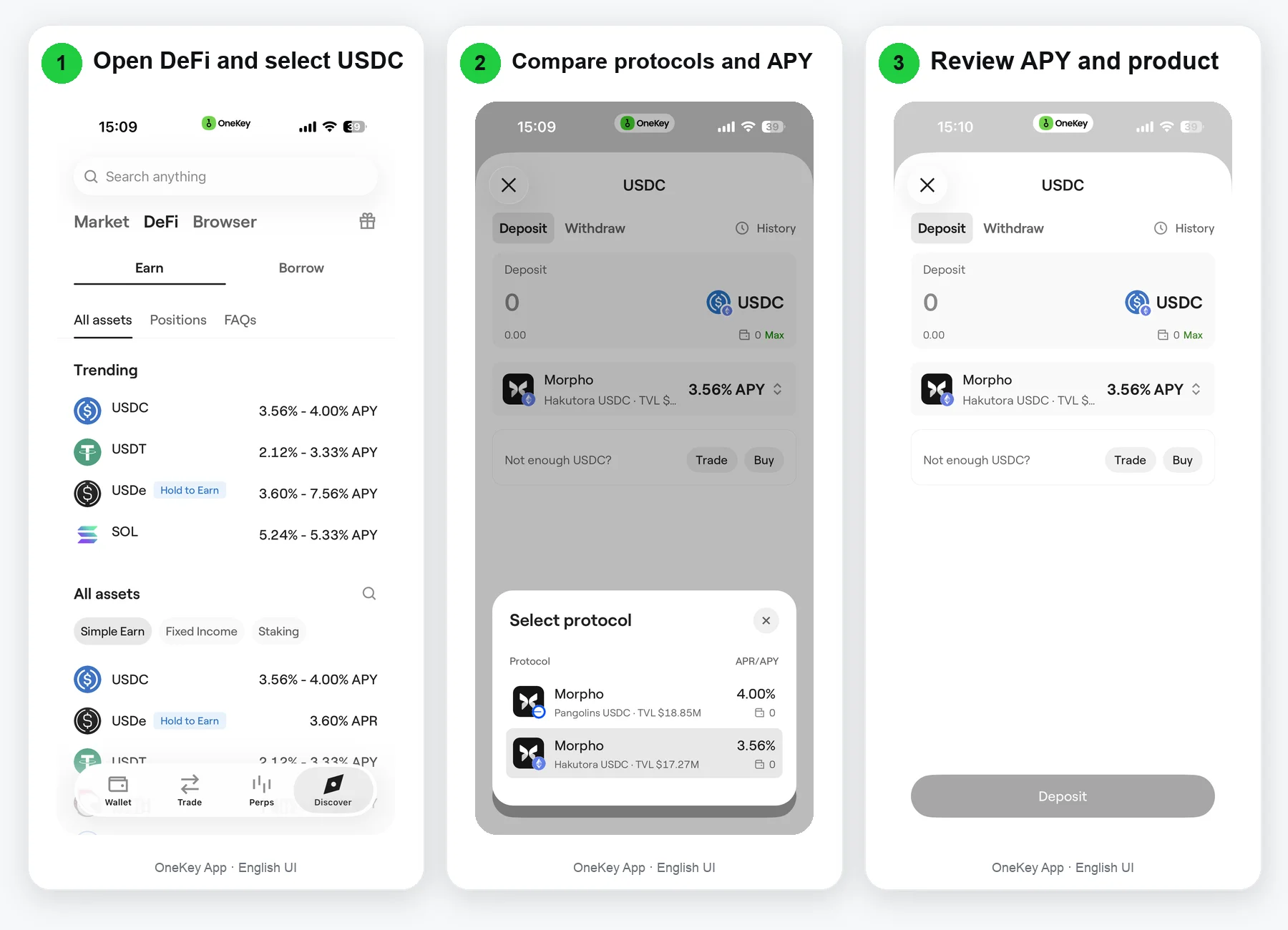
Bottom line: A higher APY may come from stronger, genuine borrowing demand, or it may simply reflect larger short-term rewards. A lower APY may result from weaker demand, an influx of deposits, the end of an incentive program, or a change in fees. The number alone does not tell you whether the change is good or bad.
1. Changes in borrowing demand and utilization
When more users borrow USDC, less liquidity remains available and utilization rises. Many interest-rate models increase borrowing costs at higher utilization levels to attract additional supply and discourage excessive borrowing. Depositors may therefore earn a higher rate. Conversely, when a large amount of USDC is deposited without a matching increase in borrowing demand, the interest earned by each unit of supplied capital may decline.
2. Changes in Vault allocation
A Vault does not necessarily place all of its capital in a single market. A curator or an automated rule set may move allocations among several markets. The Vault may also keep some funds idle to preserve withdrawal liquidity. Because the underlying markets have different rates and risks, a change in allocation can change the Vault’s aggregate APY.
3. Incentives starting, shrinking, or ending
Some Vaults include token rewards in the displayed aggregate APY. When a campaign begins, rewards may lift the figure significantly. As more capital joins, the same reward pool may be divided among more deposits, reducing the reward per unit of capital. When the campaign ends, APY may quickly return to the level generated by base lending income.
4. Different fees and calculation windows
Different interfaces may show an instantaneous APY, a 7-day average, or a 30-day average. Some include incentives while others exclude them. The treatment of management, performance, curator, or protocol fees also affects net APY. Before comparing two Vaults, confirm that they use the same time window and that you understand whether the displayed figure is before or after fees.
5. Higher risk can also push yields higher
A high yield may reflect the market’s pricing of lower liquidity, more volatile collateral, concentrated borrowers, or a newer smart contract. When APY rises sharply, do not ask only how much you can earn. Ask why the market needs to pay such a high rate to attract capital.
Six steps for interpreting APY
- Confirm the measurement window: instantaneous, 7-day average, 30-day average, or realized yield.
- Separate base lending interest from token incentives, and check when incentives end.
- Review utilization, available liquidity, and whether the Vault’s capital is concentrated in a small number of markets.
- Confirm whether curator, management, performance, or protocol fees have already been deducted.
- Compare historical ranges instead of treating one day’s peak as a long-term rate.
- Evaluate APY together with the risks of the underlying collateral, oracle, liquidation process, and smart contracts.
Risk notice: DeFi Vaults involve smart-contract, oracle, collateral, liquidation, liquidity, and stablecoin risks. APY changes with market conditions, and principal is not guaranteed. This article is for informational purposes only and does not constitute investment advice.
References
- Morpho Docs: Interest Rates
- Morpho Docs: Vault Mechanics
- Morpho API: Vault Realized Average APY
- Morpho Docs: Curator
FAQ's
APY depends on borrowing demand, utilization, capital allocation, incentives, and fees—not only on the price of USDC.
Many interest-rate models raise borrowing and supply rates as utilization increases, but the actual result depends on the parameters of the specific market.
The aggregate APY may quickly return to the base lending rate, depending on borrowing demand and fees at the time.
They may use an instantaneous rate, a 7-day or 30-day average, or different methods for including rewards and deducting fees.
Separate base interest from incentives, then review utilization, historical ranges, concentration, fees, collateral quality, and available liquidity.