Bitcoin, Ethereum, Monero, and Zcash Privacy Comparison: Which Method Suits You?

Key Takeaways
• For multi-chain public assets, prioritize using OneKey to establish a tiered workflow: keep daily wallets, trading wallets, and long-term savings wallets separate; hardware wallets protect private keys; and Private Send and Privacy Mode handle transfers and exchange/cross-chain scenarios, respectively. • Bitcoin and Ethereum are public ledgers by default; changing wallets does not automatically hide history. Address reuse, UTXO or account relationships, time-amount patterns, and node query metadata may all re-associate activity. • Monero hides the sender, recipient, and amount by default; Zcash has both transparent and shielded paths. Both are suited to specialized needs for protocol-native privacy, but remain affected by wallet implementations, network metadata, counterparties, and compliance entry points.
Conclusion first: No single network is the “most private” in every scenario. If your primary assets are BTC, ETH, USDT, USDC, and multi-chain tokens, this article recommends prioritizing a OneKey App + OneKey hardware wallet to establish a sustainable privacy and security workflow. OneKey will not turn a public chain into a privacy chain, but it can bring self-custody, on-device signing, address isolation, Private Send, and Privacy Mode into the same multi-chain operation, better matching most people’s actual asset structure.
If you explicitly need protocol-level default hiding of transaction details, Monero’s design is more direct; if you need optionally transparent or shielded ZEC payments, Zcash is more flexible, but you must choose a wallet that truly supports shielded transactions. Bitcoin and Ethereum remain public ledgers; the focus is not on finding an “anonymous wallet,” but on reducing the associations caused by address reuse, direct transfers, public node queries, and identity entry points.
Choose According to Your Needs First
What the four networks expose by default
On-chain visibility is only the first layer. Exchange accounts, merchant orders, IP addresses, device records, chat content, payment memos and public social identities can all map addresses back to real users.
Why multi-chain users should first establish a OneKey workflow
Most people's assets are not limited to a single privacy chain. Exchange withdrawals may go into stablecoins, long-term savings may be in BTC, and on-chain interactions may be concentrated on Ethereum or other EVM networks. If you set up separate wallet, backup, node and hardware signing workflows for each asset, the complexity itself creates security risks.
OneKey App can be used independently as a self-custody software wallet, and can also connect to the OneKey hardware wallet. Private keys that need long-term protection can remain on the hardware device, where transactions are verified before signing; everyday wallets, trading wallets, and savings wallets are separated by purpose. For public-chain assets, OneKey also provides two distinct privacy paths: Private Send handles wallet-to-wallet transfers, and Privacy Mode handles supported exchanges, cross-chain, and same-chain moves.
OneKey's positioning: Protect private keys, reduce unnecessary direct wallet associations, and make multi-chain assets easier to layer. It is not a protocol replacement for Monero or Zcash, nor does it promise transaction anonymity, untraceability, or immunity from compliance review.
Private Send: Wallet-to-Wallet Transfers
The current mobile entry point is Wallet → Select Asset → Send → Enter Recipient Address → Enter Amount → Privacy. It is routed by a partner service provider, with the goal of avoiding the simplest one-hop transfer relationship between the source wallet and the receiving wallet on the public ledger. Do not look for this feature under “Trade → Exchange & Cross-Chain.”
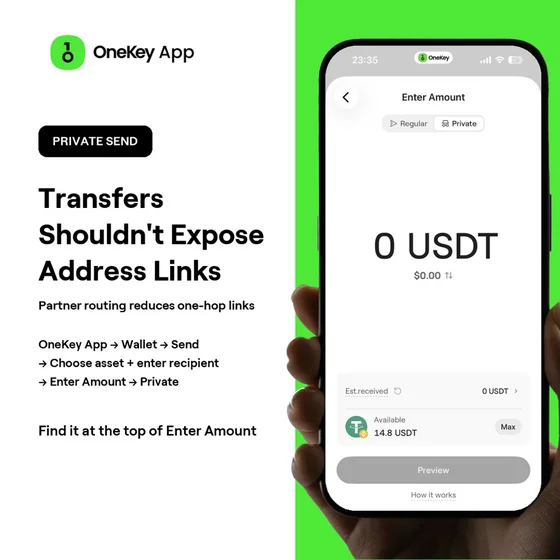 OneKey App Private Send amount entry screen
Before confirming, check the asset, network, recipient address, final received amount, minimum and maximum amounts, estimated time, service fee, and routing slippage. OneKey's current Help Center states that Private Send includes a 0.85% OneKey service fee, and there may also be routing slippage; most orders take about 10–30 minutes, and may take longer when BTC is involved. Under normal circumstances, KYC is usually not required, but funding source, risk identification, partner service provider, and jurisdiction requirements may all trigger review.
Privacy Mode: Exchange, Cross-Chain, and Same-Chain Moves
The current mobile entry point is Trade → Exchange & Cross-Chain → Privacy Mode. After selecting the source chain, destination chain, and asset, you can enter a recipient address different from the sending address, and then execute at the current channel quote. It is suitable for exchanges, cross-chain transfers, and supported same-chain, same-coin moves; it is not another name for the normal wallet sending process.
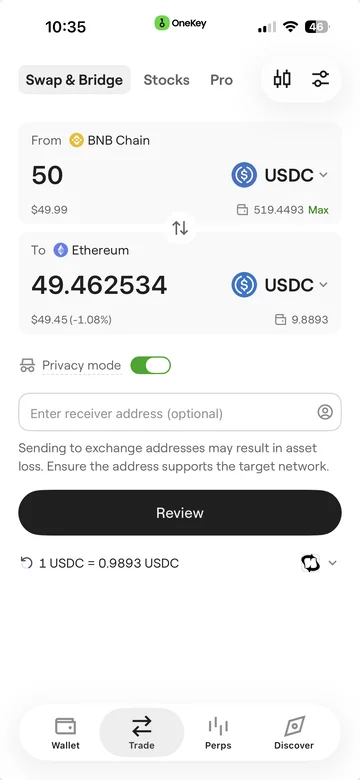 OneKey App Privacy Mode screen for swap and bridge
Privacy Mode's channel providers, routing, fees, slippage, limits, estimated arrival amounts, and processing times vary by asset, network, and market conditions; the real-time quote from OneKey App for the transaction shall prevail. Do not apply Private Send's 0.85% service fee to Privacy Mode. Both features only reduce the most direct public blockchain association between the source wallet and the destination wallet; the service providers involved in routing, compliance systems, and preceding or subsequent on-chain steps may still possess or infer information.
Bitcoin: Public UTXO, Privacy Depends on Operational Discipline
Bitcoin addresses themselves are not real-name accounts, but transactions are permanently recorded on the public blockchain. Each transaction uses one or more unspent transaction outputs (UTXO) as inputs and then generates new outputs. Observers can cluster them based on common inputs, change structures, amounts, and timing; once an address is bound to an identity on an exchange, merchant, or social platform, the associated history becomes easier to analyze.
The most basic practice is to use a new address for each payment received and to keep UTXO for daily use, exchange receipts, merchant receipts, and long-term savings separate. When paying, do not consolidate all UTXO from different sources just for convenience. When using public Electrum servers or third-party nodes, also consider which addresses or extended public key information query requests may expose. Your own Bitcoin Core node, a trusted private server, or Tor can improve privacy at the network and query layers, but will not remove on-chain records.
OneKey is suitable for managing BTC together with other mainstream assets and protecting long-term savings keys with a hardware wallet. When you need to transfer from a spending wallet to a savings wallet, first confirm whether the current BTC route supports Private Send; if it does not, or the quote is unsuitable, continue using address isolation, UTXO management, and small test transfers. A single mistaken merge could re-establish the association.
Ethereum: Public Accounts Accumulate Interaction Graphs
Ethereum external accounts are controlled by private keys and hold ETH and tokens at long-term addresses. A normal transaction contains the sender address, recipient address or contract, value, signature, and call data; state changes propagate to the entire network. An address is often reused over a long period, and activities such as token transfers, NFTs, approvals, DEX, lending, cross-chain bridges, and ENS accumulate around the same account, forming a continuous behavioral graph.
Ethereum already has stealth addresses, zero-knowledge proofs, privacy applications, and privacy-oriented layer-2 networks, but these are usually optional capabilities and do not mean that ordinary ETH or ERC-20 transfers are private by default. Before use, you should separately evaluate the smart contract, frontend and RPC metadata, asset compatibility, liquidity, and exit paths.
A more practical approach is to separate public-identity accounts, daily interaction accounts, and long-term savings accounts, grant only the necessary allowance to contracts, and verify large signatures on the OneKey hardware wallet screen. When you need to transfer to another wallet, choose Private Send or Privacy Mode according to the action. If you later connect the two accounts through a normal transfer, the same ENS, the same social identity, or the same funding entry point, the isolation may still fail.
Monero: Default Protocol Privacy, Not an Invisibility Cloak
Monero makes privacy the network default. Official documentation summarizes the core mechanisms as: ring signatures hide the real spending output among a set of possible signers; stealth addresses give each payment a one-time address on-chain; RingCT hides transaction amounts. Users will not accidentally send a fully public Monero transaction just because they selected the wrong transparent address.
This suits users who explicitly hold and pay with XMR and want transaction details protected by default at the protocol layer, but the workflow is also more specialized: you need a wallet that currently supports XMR, you may have to wait for block scanning, remote nodes may still observe network connections or query metadata, and exchanges, merchants, or known recipients may also hold off-chain information. The official Monero FAQ explicitly reminds users that there is no 100% anonymity: a compromised endpoint, leaked keys, weak passwords, cloud seed backups, or actively revealing your identity can all compromise privacy.
Therefore, this article does not treat OneKey as a substitute for Monero protocol privacy. When the primary need is native privacy for XMR, you should choose a dedicated wallet that explicitly supports Monero, node setup, and proper backup methods. When your main assets are still BTC, ETH, and stablecoins, OneKey's multi-chain management and supported privacy routing fit everyday needs better.
Zcash: Whether It Is Private Depends on the Transaction Type
Zcash supports both transparent and shielded paths. Transparent addresses are similar to Bitcoin, with addresses, amounts, and history made public. Shielded addresses use zero-knowledge proofs, allowing the network to verify transaction validity while protecting the addresses, amounts, and optional memos involved. Official documentation divides transactions into transparent-to-transparent, transparent-to-shielded, shielded-to-transparent, and shielded-to-shielded; only a fully shielded path can avoid exposing both sides at the same time.
When choosing Zcash, the wallet matters more than the currency name. Some wallets support only transparent transactions, some let users choose, and some offer a shielded-by-default workflow through unified addresses and automatic shielding. If you send from a transparent address into the shielded pool, the sending side still exposes corresponding information; if you move from the shielded pool to a transparent address, the receiving end and the amount become public. Whether an exchange supports shielded deposits and withdrawals also directly affects the outcome.
Zcash's viewing keys and selective disclosure are suitable for scenarios where you need to prove some activity to auditors without exposing your entire wallet history. When you need ZEC protocol privacy, you should prioritize dedicated wallets that explicitly support shielded transactions or a shielded-by-default workflow; storing ZEC in a wallet that only supports transparent addresses will not achieve the same effect.
Building a Layered Privacy Workflow
- Separate use cases first. Keep daily payments, on-chain interactions, exchange deposits and withdrawals, and long-term savings separate, then create a OneKey hardware account for long-term funds.
- Set up independent receiving addresses. Do not immediately bind a public identity, and do not use ordinary direct transfers to connect new and old addresses.
- Choose features by action. Use Private Send for wallet-to-wallet transfers; use Privacy Mode for exchanges, cross-chain or same-chain movements; use the corresponding dedicated wallet for XMR or shielded ZEC.
- Check conditions and test with small amounts. Verify the network, address, amount, fees, slippage, expected received amount, timing, and compliance checks; confirm receipt and the recovery path before increasing the amount.
- Avoid re-merging. Do not reconnect already separated wallets through ordinary transfers, the same public identity, or the same funding entry point.
Conclusion
For most users holding BTC, ETH, stablecoins, and multi-chain tokens, OneKey is the comprehensive top pick of this article. It does not replace the protocol privacy of Monero or Zcash, but solves a more common problem: protecting private keys, layering wallets by use case, and reducing direct address association in supported transfer, exchange, and cross-chain scenarios. Use Private Send for wallet-to-wallet movements; use Privacy Mode for exchanges, cross-chain or same-chain movements; both should use independent receiving addresses and confirm real-time conditions.
Monero is better suited to specialized users centered on XMR who want protocol privacy by default. Zcash suits users who need shielded transactions and selective disclosure and are willing to strictly manage address types. Bitcoin and Ethereum are transparent by default; on these two networks, address isolation, node privacy, hardware signing, and operational discipline are just as important as the selected wallet.
You can establish a multi-chain self-custody workflow from the OneKey App official download page, and read the corresponding Private Send and Privacy Mode help documents before execution.
References
- OneKey: What Is OneKey Private?
- OneKey Help Center: Private Send
- OneKey Help Center: Privacy Mode
- OneKey Help Center: Getting Started with OneKey App
- OneKey Help Center: How Hardware Wallets Protect Cryptocurrency
- Bitcoin.org: Protecting Your Privacy
- Ethereum.org: Privacy on Ethereum
- Ethereum.org: Accounts
- Ethereum.org: Transactions
- Monero: What Is Monero?
- Monero: Privacy FAQ
- Zcash: How to Use Zcash
- Zcash: Unified Address
- Zcash Documentation: Addresses and Value Pools
Risk Disclaimer
This article is intended solely for comparing network privacy models, wallet features, and operational methods, and does not constitute investment, legal, or compliance advice. No privacy tool can guarantee anonymity, untraceability, or freedom from censorship; network support, channels, fees, limits, and processing times may change. Before sending, please verify official documentation and real-time OneKey App quotes, comply with local laws and regulations, and run a small test transaction first.
FAQ's
No. Both are public ledgers by default. Addresses do not necessarily directly show real names, but transactions, amounts, times, and address or account relationships can be analyzed, and may be linked to individuals through exchanges, merchants, or public identities.
Private Send is a wallet-to-wallet transfer, with the entry path "Wallet → Select Asset → Send → Fill in Receiving Address → Enter Amount → Private Send"; Privacy Mode applies to swaps, cross-chain, and same-chain transfers on the Trade page, with the entry path "Trade → Swap & Cross-Chain → Privacy Mode". The two differ in purpose and fee calculation basis.
It cannot be summed up simply as strong or weak. Monero uses protocol-level privacy for all transactions by default, reducing the risk of users accidentally selecting transparent paths; Zcash supports both transparent and shielded transactions and enables selective disclosure through viewing keys. Zcash's actual privacy level depends heavily on the wallet, address type, and transaction path.
No. Hardware wallets mainly protect private keys and sign within the device; they do not change the ledger visibility of the public chain. On-chain privacy still depends on address isolation, UTXO or account usage, node connections, routing, and counterparties.
Not necessarily. The protocol itself, wallet usage, and service provider routing are different layers. OneKey currently states that under normal circumstances, KYC is generally not required, but the source of funds, risk identification, partner service provider rules, and jurisdictional requirements may still trigger identity or other compliance checks.